On 1 May 1960, Cardijn left for Germany, where he visited Aachen, Bonn and Munster.
SOURCE
Archives Cardijn 1367
On 1 May 1960, Cardijn left for Germany, where he visited Aachen, Bonn and Munster.
SOURCE
Archives Cardijn 1367
Five weeks after returning from Rome, Cardijn sent a 5000 word document entitled “L’Eglise face au monde du travail” (The Church facing the world of work) to Archbishop Dell’Acqua to assist in the drafting of an encyclical to mark the 70th anniversary of Rerum Novarum.
“The note, which I wrote in a single session, focuses particularly on the international aspect of the world of work and the problems it raises. I certainly have not presented the Church’s whole doctrine on justice as would have been necessary. The text in fact is merely a series of reflections drafted by hand without any pretensions.
“I have just opened the book by Fathers Calves (sic, should be Calvez) and Perrin SJ: “Eglise et société économique : l’enseignement social des Papes, de Léon XIII à Pie XII (1878-1953)“. Collection « Théologie » publiée sous la direction de la Faculté de théologie S.J. de Lyon-Fourvière – Editions Montaigne, Paris 1959 (“Church and economic society: the social teaching of the Popes, from Leo XIII to Pius XII (1878-1953)”. “Theology” collection published under the direction of the SJ Faculty of Theology of Lyon- Fourvière – Editions Montaigne, Paris 1959.) It includes a very broad selection of pontifical texts.
“As I suggested to Your Excellency in my previous letter, a study committee could prepare a draft, as was done for Rerum Novarum and Quadragesimo Anno.
“I beg Your Excellency’s pardon for the simplicity of my suggestions but I believe that the time is truly ripe for a psychological shock in the world. Perhaps we could announce the new encyclical a little later and thus prepare great publicity for it and a great impact in every continent,” Cardijn wrote.
The Church faces the world of work
He takes up these themes in greater detail in his actual note, which is organised around his iconic Three Truths of Reality (See), Faith (Judge) and Method (Act) dialectic.
I. Truth of Reality: The universal dimension of the problem
“Never has the worker problem experienced the dimension, significance or gravity that it has today,” Cardijn begins in his usual apocalyptic style. “All the more so since its present dimensions do not signify the ultimate end point; on the contrary this is merely the beginning of a vertiginous transformation, both concerning work itself and all the actors who are engaged in it, and concerning the unheard of repercussions of this transformation on all aspects of the life of the whole of humanity.
“Not only the manner and life of work have been and are continuing to be transformed from day to day, but labour is in the process of turning the whole world on its head, creating an increasingly technological world, changing the very regime of work as well as the various aspects of human life – personal, family, social, cultural and recreational, political, national and international,” he insisted.
He continued noting that while both Leo XIII (Rerum Novarum) and Pius XI (Quadragesimo Anno) had dealt with the issue of work and labour in their encyclicals, Pius XII had not done so even if he had taken up various aspects in many of his speeches.
Now, however, the issues of work and labour had taken on a “universal dimension.”
“Today, the future of work has become a global problem, the No. 1 problem, one might say. It is increasingly becoming so: through the perfecting of new labour processes, which have spread rapidly in every country and among all races; through the growing number of wage workers, both young and adult – and particularly women and young girls – in all sectors of professional life (production, trade, finance, administration, teaching, transport, publicity); through the power of new technologies which overcome all obstacles and thus transform the face of continents as well as the life of peoples; through scientific, social and ultimately philosophical problems that have led to this evolution, through which man increasingly masters matter at the risk of allowing himself to become dominated by it,” Cardijn wrote.
He paints a dramatic picture of the effects of all this:
“It is technology with its applications in every aspect of life – which enables the most primitive peoples to move without any transition to the most modern conditions of life; it is also technology which multiplies the tentacles of urban and industrial agglomerations, which are also the source of deep-seated uprootedness; it is also technology which responds with irresistible advertising for the most unhealthy products, the most upsetting processes and aspirations, the most sensational news.
“In the frenzied race to conquer the world and the insatiable search for immediate profit, work, expenses and the labour regime, the growing number of workers are all dragged into a world that is divided into two economic groups: the under-developed and the over-developed, and into two ideological groups: the communist world and the capitalist world. This economic, social, cultural and ideological transformation is unfolding under our very eyes at a time when so many new peoples, and especially in Africa, which are achieving independence and are seeking capital, technicians, political alliances which will assist them to achieve their destiny.”
II. Truth of Faith: The truth about work and the world of the worker
Cardijn continues with one of the most developed outlines of his theology of work.
“In the present conditions of the world transformed by work, the anniversary of Rerum Novarum presses the Church to proclaim more solemnly still the TRUTHS which must be the base of a world regime for truly human and Christian labour. It has received a divine mandate to spread the knowledge of it,” he wrote.
1. The end of work is the transformation of the wealth of nature for the service of people and for the glory of God.
Work is not a punishment for sin, a kind of condemnation. Nor is it the supreme end for those who work; one cannot turn it into an absolute, a god.
Human work is a privilege, an honour, because it demands the collaboration of man in the divine work of Creation and Redemption in order to satisfy in an increasingly adequate way the needs of the community. Without work, there is no genuine humanity, no genuine civilisation. The fatigues and abuses that accompany work are the consequences of sin.
Therefore workers are not “the wretched of the earth”, machines or slaves; they are not objects, instruments of toys; they are the sons and daughters of God; they are the very end of work.
2. This is why the Church, as divine Providence itself, desires, encourages and recognises the value and the legitimacy of all progress in science and technology. It wants them, not for the benefit of a tiny minority, but so that they will enable the needs, both spiritual and material, of the whole of humanity to be satisfied.
3. Technological and economic progress demands an increasingly sophisticated organisation of labour, within which various interests must be reconciled for the good of all.
4. The more the world of labour becomes an international complex, either in the sourcing and use of new products, or in the search for new manufacturing processes, or in the distribution of products manufactured on a market that has become global, the more the sense of responsibility and international justice must inspire a collaboration and a solidarity, that ensures the access of all in justice – not the privileged few but the innumerable mass of the most humble – in all the material and spiritual progress of civilisation.
5. However no form of economic, social or cultural organisation – as perfect as one could conceive of it and implement it – will be able alone to transform man (individual human life, family life and social life), neither to satisfy all the needs, whether secular or religious.
One can only arrive there by spreading, inculcating a new conception of the world, a unified and solidary world; and in changing the mentalities on the basis of mutual understanding and assistance; and to say it all by changing people in line with the teaching of the Gospel.
This transformation of man from the inside must be the object of an ongoing education: that of the child, that of the young man and of the young girl, that of the adult. And it will be all the more necessary in the future, since personal and social life will be more influenced by technology and by the complexity of human problems to resolve.
An integral human education supposes and demands a climate of freedom and unconditional support which alone can guarantee its effectiveness. Religion must play a fundamental role in the whole effort of social and international education. Also the Church has the right to respect and consideration all the more necessary since its task in this field will be increasingly urgent and more difficult. In such a manner that its action powerfully helps to give a real value to technological progress: far from enslaving or downgrading man, it must serve to raise and save him, in order to finally result in a totally solidary humanity.
III. Truth of Method: The specific role of the Church
“The Church’s mission is not to realise itself the transformations which have just been mentioned, nor to create scientific, technological, economic, social and political institutions responsible for the world of labour. The means for achieving these objectives forms part of the immediate responsibility and initiative of people themselves, both governments and private associations,” Cardijn writes.
“However, as has been said, the Church has the duty to spread the eternal truths that must guide both individuals and collectivities in the search and use of technologies and institutions, which all must be at the service of man, his temporal vocation and his eternal destiny. Teaching these truths, integrating them into the whole of human and Christian life, forms an integral part of its evangelising mission, in which the hierarchy, the priesthood and the laity have their distinct but essential roles in the expansion of the Reign of God on earth.
“And while it wants to achieve the full dimensions of this task, the Church cannot allow itself to be enclosed in the community of the faithful which constitute it; it must open out to all people of good will. This is why it wishes to collaborate with all the human institutions, both private and public, national and international, which seek in the respect of their reciprocal mission, the means to ensure the happiness of peoples and the Reign of God,” Cardijn explained.
The Church had several specific roles in this, Cardijn proposed:
a) Teaching the social doctrine of the Church
b) Formation of the laity
c) Formation of young people in particular for the world of work
d) Promoting collaboration and fraternal union.
A manifesto for Vatican II
Although he made no mention at all of the coming Council, it is difficult to interpret this magisterial document as anything other than his own personal manifesto and proposed agenda for the Council.
SOURCES
Original French
Cardijn à Archbishop Dell’Acqua (Joseph Cardijn Digital Library)
Joseph Cardijn, L’Eglise et le monde du travail (Joseph Cardijn Digital Library)
English Translations
Cardijn to Archbishop Dell’Acqua (Joseph Cardijn Digital Library)
Joseph Cardijn, The Church and the world of labour (Joseph Cardijn Digital Library)
On 5 April 1960, Pope John XXIII appointed Bernard Yago as archbishop of Abidjan, Côte d’Ivoire (Ivory Coast).
After studying at the Institut Catholique de Paris from 1957-59, he returned to Abidjan where he served as the chaplain to the Catholic Action movements.
Former IYCS leader, Lazare Kabran reports that Mgr Yago continued to support the movements in his role as archbishop.
SOURCE
Bernard Cardinal Yago (Catholic Hierarchy)
Bernard Yago (Wikipedia)
PHOTO
Archbishop Bernard Yago (La Croix Africa)
On 10 March 1960, the Belgian Catholic paper, La Cité carried a report of the visit to Rome by Cardijn and Romeo Maione.
“On Wednesday 2 March, the Holy Father received Mgr Jos. Cardijn, chaplain general and Mr Maione, president of the International YCW, in private audience,” the report said.
“They visited Rome for six days to inform the Authorities of the Secretary of State, the Propagation of the Faith and the other Roman Congregations of the activities of the YCW in the various continents.
“Not content with reporting the major actions carried out in Latin America during 1959 – action which culminated in the meeting of the International Executive Committee in Havana, Cuba and a Study Congress of South American leaders of the YCW in Lima, Peru, International YCW leaders took the opportunity to submit to the Holy Father the objectives and the program of two new very important Continental Meetings which will take place in the coming months.
“The first will bring together 70 YCW delegates from countries in the Far East and the Pacific (including Australia and New Zealand) in the Malaysian capital, Kuala Lumpur, from 26 March to 3 April. The second will be addressed to jocist leaders in the Black African countries in Leopoldville, from 1-7 August.
“Monsignor Cardijn and Mr Maione received a warm welcome everywhere. For his part, the Holy Father, also exhibited even greater confidence and hope in the apostolate of the YCW, recalling with pleasure the autograph letter which He had addressed to its founder in April 1959. He gave the visitors his most fraternal Blessing for all YCW members and for all young workers of the world.”
SOURCE
Archives Cardijn 1299
Cardijn arrived in Rome in late February 1960 with IYCW president, Romeo Maione.
According to his notes of the trip, he was filled with “pessimism” after the first two days of meetings with several priests and with the ACLI, the Italian Catholic labour movement.
All this was transformed, however, when he met with Archbishop Dell’Acqua who informed him that he had been able to arrange a private audience with John XXIII.
This took place on 2 March 1960.
And as he had foreshadowed in his preparatory notes, Cardijn did indeed propose an encyclical to commemorate the 70th anniversary of Rerum Novarum, which was due in May 1961.
Here are his notes of the meeting in the original French although it is not always easy to distinguish what Cardijn himself had said from what John had told him:
“Mercredi des Cendres 2 mars I960 (11.45 heures à 12.15 heures) – Audience privée.
1. Voilà la Jeunesse et voilà la vigueur !
2. Remerciements pour messages à Lima, à Kuala-Lumpur, à Léopoldville. Des chefs, des responsables. Importance des trois continents.
3. Il faut être ouvert à tous: orthodoxes, protestants et tous les autres. Ne pas être contre, mais pour ; les comprendre. Les catholiques ont aussi leurs défauts et leurs fautes. (A clarifier ! : Note manuscrite de Marguerite Fiévez)
Ne pas s’arrêter à des points accessoires. Les 12 articles du Credo suffisent.
4. Les catholiques s’opposent parfois à la réunion ; par ex. en Angleterre. Ils ont souffert pendant trois siècles.
5. Le problème du travail en 1960 n’est plus celui de Léon XIII, ni même de Pie XI. Personne n’aurait pu prévoir ses dimensions, son unité, son universalité, sa technicité. Les grandes Institutions internationales : le BIT, l’UNESCO, l’ECOSOC, etc…toutes ces influences sur toutes les races, sur toute la jeunesse. Une encyclique sur le monde du travail d’aujourd’hui ferait plus de sensation que Rerum Novarum et Quadragesimo Anno. Mais positive, ouverte aux collaborations nécessaires.
Il faut faire une note là-dessus et l’envoyer.
J’ai vécu longtemps avec Deploige, Pottier, Mgr Vanneufville, Tiberghien. Le Cardinal Mercier est venu à Bergamo.
—————
Prêtres ouvriers reçus par le Saint Père
—————
Le Synode de Rome : Il y a cinquante ans, 100.000 habitants à Rome – maintenant, 2 Millions.
On va canoniser bientôt un Cardinal. Se promenant un jour près de Padoue au milieu des enfants, il disait aux mères : « Courage, le bon Dieu donnera de plus grandes marmites ». (A Romeo) Vous êtes marié ? et vous avez deux enfants – quel âge ont-ils ? on attend un troisième.
L’indépendance du Congo. Autorité du Roi Baudhuin. La nature ne fait pas de saints. Il faut des périodes de transition.
Photo – bénédiction pour tous – accolades.”
And here is an English translation:
“Ash Wednesday 2 March, I960 (11.45 a.m. to 12.15 p.m.) – Private audience.
1. Look at these Young People and look at the vigour!
2. Thanks for messages for Lima, Kuala-Lumpur, Leopoldville. Heads, leaders. Importance of the three continents.
3. We need to be open to everyone: Orthodox, Protestants and everyone else. Not to be against, but for; understand them. Catholics also have their faults and errors. (To be clarified!: Handwritten note from Marguerite Fiévez)
Don’t waste time on incidental points. The 12 articles of the Creed are sufficient.
4. Catholics sometimes oppose reunion; eg. in England. They suffered for three centuries.
5. The problem of work in 1960 is no longer that of Leo XIII, nor even of Pius XI. No one could have foreseen its dimensions, its unity, universality, technicality. The major international institutions: the ILO, UNESCO, ECOSOC, etc … all these influences on every race, on all young people. An encyclical on today’s world of work would create a greater sensation than Rerum Novarum and Quadragesimo Anno. But positive, open to necessary collaborations.
A note about it needs to be drafted and sent.
I lived for a long time with Deploige, Pottier, Mgr Vanneufville, Tiberghien. Cardinal Mercier came to Bergamo.
—————
Worker priests received by the Holy Father
—————
The Rome Synod Rome: Fifty years ago, 100,000 inhabitants in Rome – now 2 million.
We will soon canonise a Cardinal. Walking one day near Padua among the children, he said to the mothers: “Courage, the good Lord will give larger pots”. (To Romeo) Are you married? and you have two children – how old are they? we are waiting for a third.
The independence of the Congo. Authority of King Baudouin. Nature does not make saints. Transition periods are necessary.
Photo – blessing for all – braces.”
In any event, it is clear that the three men had a wide-ranging discussion. John was obviously concerned with interfaith issues but Cardijn managed to get his point across about the need for an encyclical.
Later, Cardijn spelt out further details of his conversation with the pope as follows:
“The [social] question is not the same in 1960 as it was in the time of Leo XIII or even in the days of Pius XI,” he told the pope.
“An encyclical on the world of work of today would have even more influence than Rerum Novarum or Quadragesimo Anno, but an encyclical that is positive and open to all the collaboration required!” he suggested, no doubt also with an eye to the forthcoming Council.
John responded positively asking Cardijn to detail his proposal in a written note that Cardijn would waste no time in drafting.
Worker priests
Significant too is the reference to worker priests visiting John XXIII, who had been nuncio in France when they first began to have problems with the Holy See under Pius XII.
Moreover, the clampdown had continued under his pontificate with a new directive nine months earlier prohibiting priests from working fulltime outside the Church.
But what did Cardijn say or ask? What was John’s response?
Personal links
John’s comments that he had lived with Deploige, Pottier, Vanneufville and Tiberghien are also illuminating.
A lawyer who later became a priest, Simon Deploige had been Cardijn’s sociology and social economy professor at Louvain in 1906. Fr Antoine Pottier was a Belgian priest, who promoted a just wage, cooperatives and trade unions who was eventually transferred to Rome after opposition from local conservative politicians.
Gaston Vanneufville and Jules Tiberghien were two French priests from Lille, who had strong links with the Catholic social movement there and who had assisted the Sillon during their period of difficulties. Later Fr Vanneufville also helped Cardijn navigate the Roman bureaucracy.
If Cardijn and John had felt a bond after their first meeting in 1959, the discovery of these close personal links must have drawn them even closer.
SOURCE
French
Joseph Cardijn, Visite à Rome, février – mars 1960 (Joseph Cardijn Digital Library)
English
Joseph Cardijn, Visit to Rome, February – March 1960 (Joseph Cardijn Digital Library)
As usual, Cardijn’s preparation for his planned trip to Rome in late February 1960 was minutious.
Even the list of people he planned to visit is impressive.
Archbishop Angelo Dell’Acqua, the Substitute at the Vatican, with whom Cardijn has been in regular contact since his appointment in 1954 to replace Mgr Montini, who had been promoted to archbishop of Milan.
Cardinal Fernando Cento had previously been nuncio to Belgium from 1946 to 1953.
A tough-minded conservative who had been Substitute for Pope Pius XI from 1929-35, Cardinal Alfredo Ottaviani had only recently been appointed as Secretary to the Vatican Holy Office. The son of a working-class baker, Ottaviani, was sympathetic to Cardijn and the JOC.
Now the Secretary of the Congregation for the Propagation of the Faith, Archbishop Pietro Sigismondi was previously the nuncio to Rwanda the Belgian colony that hosted one of the strongest JOC movements in Africa.
Lebanese-born Cardinal François Agagianian was the Pro-Prefect of the Congregation for the Propagation of the Faith.
Soon to be appointed as a cardinal, Archbishop Pietro Marella became nuncio to France succeeding the then-Archbishop Roncalli in 1953 and would serve in that role until the end of 1959.
Archbishop Antonio Samorè was the secretary of the Congregation for Extraordinary Ecclesiastical Affairs, the foreign affairs branch of the Vatican Secretariat of State.
Cardijn knew and had working relationships if not friendships with them all.
In addition to these Vatican personalities, Cardijn planned to see Fr Jean-Baptiste Janssens, the Belgian-born superior general of the Jesuits, along with the heads of other missionary orders whose priests worked closely with the JOC, including the Oblates, White Fathers and Holy Cross Fathers.
He planned to visit Archbishop Maximilien de Fürstenberg, the rector of the Belgian College in Rome. Interestingly, he also planned to visit the Opus Dei priest, Fr (now Blessed) Alvaro del Portillo, who was on the “Commission laïcs pour le Concile” (Laity Commission for the Council).
In addition, he also foreshadowed a visit to Mgr Achille Glorieux, the French-born former JOC chaplain from Lille, who was secretary to the Permanent Committee for the Apostolate of the Laity.
Most of the topics Cardijn listed for his discussions revolved around the work of the YCW on the various continents and regions.
Particularly interesting and significant, however, is Cardijn’s note of issues to raise with Archbishop Dell’Acqua:
“Peut-on suggérer une Encycllque ?
a/ à l’occasion du 70ème anniversaire de Rerum Novarum, sur ‘L’Eglise face au monde du travail’
b/ pour dissiper le désarroi et la confusion sur « L’ Apostolat des laïcs ».”
“Could we suggest an Encyclical,” Cardijn asks,
“a/ on the occasion of the 70th anniversary of Rerum Novarum on “The Church and the world of work”
“b/ to dissipate the disarray and confusion over ‘The Lay Apostolate’.”
“The Church and the World of Work” and “The Lay Apostolate”: two themes at the heart of Cardijn’s mission.
Clearly, he was also highly concerned about the “disarray” and “confusion” over the latter.
Although he makes no specific mention of the Council, surely it was not absent from Cardijn’s thoughts.
SOURCE
Voyage à Rome de Mgr Cardijn et Romeo Maione (Joseph Cardijn Digital Library)
Trip to Rome of Mgr Cardijn and Romeo Maione (Joseph Cardijn Digital Library)
On 11 February, 1959, Msgr Antonio Bacci published an article in Osservatore Romano, entitled “What Language Will be Spoken at the Forthcoming Ecumenical Council?”
He noted that people were suggesting the use of popular languages and of simultaneous translations in order to overcome the difficulties that many bishops have in speaking Latin or in understanding it when it is pronounced in so many different ways.
Bacci acknowledged some merit in these objections, but to admit them would be for the Church to contribute to Latin’s decline. Nevertheless, modern languages could be used in conversations and small meetings, he said.
If the professors and students at the Gregorian University and other Roman institutions can make use of Latin, Bacci argued, surely the members of the Council could also do so. Even if they did not do so perfectly, it would force them to speak scientifically, precisely, and clearly for which scholastic Latin is wonderfully apt.
Moreover, Latin was an instrument of the Church’s universality that it had developed over the centuries to serve its needs.
SOURCE
Joseph Komonchak, The antepreparatory period (JA Komonchak)
On 6 February 1960, Pope John named Fr Joseph Goupy, who had been diocesan chaplain to the JEC (YCS) in the Diocese of Tours, as co-adjutor bishop of Blois.
SOURCES
Bishop Joseph-Marie-Georges-Michel Goupy (Catholic Hierarchy)
Dominique-Marie Dauzet et Frédéric Le Moigne (sous la direction de). Dictionnaire des évêques de France au XXe siècle. Paris, Éditions du Cerf, 2010, 307-308.

In February 1960 as part of his preparation for his forthcoming to Rome to visit Vatican officials and Pope John XXIII, Cardijn drafted a short paper, “Les prêtres et la doctrine sociale de l’Eglise” or “Priests and the social doctrine of the Church.”
He began by lamenting the lack of understanding of Church teaching that he had observed during his recent trip to the Americas.
“People everywhere complained about the fact that priests do not know the Church’s Social Doctrine and therefore do not spread it; that in practice they feel powerless in the face of social injustice, which seems to them to be the sole responsibility of temporal institutions.
“In general, they never speak, either from the pulpit or in parish meetings, about lay apostles, or the major problems of Latin America and the world, e.g. undernourishment, slums, lack of hygiene and social security, insufficient wages and unemployment, illiteracy.
“Rare are those who exalt the dignity of human work, of workers, worker families and their most basic rights,” Cardijn wrote.
As a result, priests failed “to think of training and organising young people or adults to seek together how to deal with the needs of their reality, their country or the world.
“Yet the Church’s Social Doctrine is nothing other than Christ’s doctrine regarding God’s plan in time as in eternity, on earth as in heaven,” Cardijn insisted.
“This mission entrusted by God to man, whom he created in his own image and likeness, makes him the irreplaceable collaborator of God, both in the work of creation and the work of redemption. Hence, the doctrine of Christ and the Church on the value of work, the dignity of the worker and his family, on the respect due to the poorest and most humble in a society animated by the Christian spirit. Is this not the only positive response to either communist or capitalist materialism?”
“If God has entrusted the implementation of His earthly plan to man, it is up to the Church to make it known to Christians and through them to humanity.
“Quomodo audient sine praedicante?” The faithful and parishioners will never be imbued with the Church’s Social Doctrine and be proud to spread it, convinced of their social mission, if the priest and the clergy in general do not evangelise them in a concrete and practical way.
“Moreover, the Church’s Social Doctrine is inseparable from its spiritual doctrine. This would be an evasion, and charity would become an artificial, fake, arbitrary kind of generosity, if it did not include justice as the basis of all human relations, including personal, family, social, economic, cultural, political, national and international.
“An individualistic conception of religion oriented only towards worship or towards a vague or simply alms-giving kind of charity is one of the greatest dangers facing the Church today,” he warned.
Instead, “Catholics must be the pioneers of a social apostolate capable of dealing with current problems.”
“The social and economic, technical and scientific transformations – which are taking place in Latin America as elsewhere – make the Church’s Social Doctrine even more urgent than ever,” Cardijn argued.
“The mass of humanity is abandoned to exploitation by the absence of a social doctrine which ensures respect for the weakest in all aspects of its earthly life, and its participation in the whole progress of civilisation,” he lamented.
Hence, the clergy needed to deal with “problems of underdevelopment.”
“Only positive formation, information and participation in international movements of apostolic action will be able to provide members of the parish or diocesan community with the means not only of forming their own consciences but of collaborating effectively in the solution of these issues problems,” he added.
“Man is a social person with a right to all the training and assistance necessary for this participation. If the masses are not encouraged to organise, this guarantees social disorder which is also the cause of temporal evils, and which moreover, is an offence to the Creator and the Redeemer.
“The formation of the disciples of Christ, from whatever social rank, includes this authentic lay apostolate, which will become increasingly urgent and must reach the whole of humanity,” Cardijn argued.
The more we proclaim it, the more this spirit of service will penetrate minds and institutions. And the more we invite the faithful to seek the means to incarnate and realise this spirit, the more the Church will raise up the militants and the apostles that the new world needs in order to be truly animated by the spirit of Christ. Secularism can only be overcome by the laity. And the laity can only be awakened and formed by the clergy.
As a result, priests also needed a social formation beginning with their seminary training. “Far from remaining theoretical, it needs to become increasingly practical, so that after leaving the seminary the priest will have not just learned doctrine but been initiated into action and organisation so as to to be able to become himself the formator, the animator and the trainer of the laity, including young people and adults.
“Seminarians, especially those in their final year, must not remain strangers to and distant from the movements of the lay and social apostolate. Pastoral courses need to include this initiation and learning, which supposes that the teachers themselves have been initiated into it,” he insisted.
And this needed to continue with priests already in ministry.
“A common front of the Church in the social field is as necessary as in the field of worship. Then the Church will display, at its head as in its members, the true face of Christ everywhere, and the whole world will have, and will be able to proclaim that it really carries out the mission of its founder: ‘Evangelizare pauperibus misit une’,” he concluded.
SOURCE
Les prêtres et la doctrine sociale de l’Eglise (Joseph Cardijn Digital Library)
English translation
Priests and the social doctrine of the Church (Joseph Cardijn Digital Library)
On 20 January 1960, Jean-Pierre Delarge writes to Marguerite Fiévez enquiring as to whether Cardijn had been able to make progress on his book.
SOURCE
Archives Cardijn 1778
On 4 January 1960, “social employer” Jean Lannoye writes to Cardijn informing him that he chairs Editions Universitaires and that Jean-Pierre Delarge is his son-in-law and that the publishing house would be very happy to publish Cardijn’s book.
SOURCE
Archives Cardijn 1778
REFERENCE
Jean Lannoye, un ‘patron social’ (Retro Rixensart)
On 16 December 1959, Pope John appointed Fr Henri Gufflet as coadjutor bishop of Limoges, France.
Later he would be appointed as the prelate of the Mission de France.
SOURCE
Bishop Henri Marie Charles Gufflet (Catholic Hierarchy)
Territorial Prelature of the Mission de France at Pontigny (Wikipedia)
PHOTO
Bishop Gufflet with Mgr Denis Tapsoba (Diocese of Limoges)
Cardinal Tardini’s announcement that much of the Council’s work would be done by correspondence even before the bishops met in Rome immediately raised fears.
Belgian Dominican Jérôme Hamer reported Tardini’s comments in a letter to Yves Congar on 7 November 1959:
“The Cardinal gave us to understand that a great part of the work prior to the Council could take place by correspondence, thus shortening the presence of the Fathers in Rome. Here is the outline he presented:
a document prepared in Rome by one of the preparatory commissions to be named; sent to the bishops;
registering their reactions (refusal, simple acceptance or with amendments); redaction of a new document or reworking of the previous one;
finally, meeting of the Fathers in the Vatican to take a stance on a document that has already been reworked and would have received an initial rather general approval in the way indicated above.”
Congar recorded his reaction in a margin note on the letter:
“It’s a prefabricated Council. It’s the procedure followed for the Immaculate Conception and the Assumption. This wouldn’t be a real Council!”
SOURCE
Joseph Komonchak, The antepreparatory period (JA Komonchak)
At a press conference on 30 October, 1959, Cardinal Tardini officially announced that the Council would be called “Vatican II.”
The chief aim would be “to foster the growth of the Catholic faith, a healthy renewal of
the Christian people’s practice, and an updating of Church discipline according to the needs of the day.”
While it would be “an internal affair of the Catholic Church,” it would “represent so
marvelous a spectacle of truth, unity, and love as to constitute, even for those alienated from the Apostolic See, an invitation to seek and to achieve that unity to which many of them aspire.”
Whether non-Catholics would be invited as observers was a matter under discussion.
The preparations were well underway, Tardini reported.
Eighty per-cent of the residential bishops had already submitted recommendations, and it was likely to require a full three years of further work before the Council could meet. He expected that it would not be of long duration, both so that bishops would not be absent from their sees too long and because of the highly organized preparations.
“An immense correspondence with Bishops all over the world” was to be carried on prior to the Council to ensure that “we will already be agreed on many things by the time the Council meets,” Tardini noted.
SOURCE
Joseph Komonchak, The antepreparatory period (JA Komonchak)
On 26 October 1959, Bishop Charles-Marie Himmer of Tournai, a long-standing proponent of the JOC and Specialised Catholic Action, wrote to Vatican Secretary of State, Cardinal DomenicTardini, with his reflections for the Ante-Preparatory Commission.
He first sought clarification on “moral” issues, particularly marital questions. He also raised the issue of using vernacular language in the mass and the use of more appropriate scriptural readings.
Finally, he sought clarification of the notion of Catholic Action, which had been under challenge in various quarters.
He wrote;
“Rogatur ut conceptus actionis catholicae a Pio XI traditus elucidetur et servetur ad rite secernendam hanc apostolatus laicorum formam nostris temporibus maxime adaptatam ab aliis speciebus apostolatus in quibus laici sese devovent.”
Rough translation based on Google
It is requested to clarify the concept of Catholic Action that Pius XI regarded as especially adapted to our times for the promotion of the apostolate of lay people…
SOURCE
Archives Himmer (Diocèse de Tournai)

On 29 August 1959, Marguerite Fiévez responds to Delarge apologising for the delay because she had been in Switzerland convalescing on doctor’s instructions.
She says that she had promised not the draft of a whole book but only two chapters, which were nearly ready.
And she further explains and apologises for the difficulties of following Cardijn, who was always so “mobile.”
SOURCE
Archives Cardijn 1778
On 6 August 1959, L’Osservatore Romano announced the appointment by Pope John XXIII of a new management committee for COPECIAL, following the departure of Vittorino Veronese, who had been appointed secretary-general of UNESCO.
The six members were:
There was an obvious absence of worker representation here and, no doubt after some feedback if not protest, this was remedied by the addition of three more members:
SOURCES
Bernard Minvielle, L’apostolat des laïcs à la veille du Concile (1949-1959)
Golzio, Silvio (Treccani)
Ramon Sugranyes de Franch (Website)
Ramon Sugranyes de Franch (Wikipedia.fr)
Tribute to Ramon Sugranyes de Franch (Pax Romana ICMICA)
Karl, 8th Prince of Löwenstein-Wertheim-Rosenberg (Wikipedia)
PHOTO
Ramon Sugranyes
On 5 August 1959, Delarge writes again to Marguerite Fiévez seeking the first draft of Cardijn’s text that she had promised him for 20 July.
SOURCE
Archives Cardijn 1778
On 18 July , the Holy See wrote to Catholic universities and all faculties of theology seeking their feedback and advice on the preparation for the Council.
They were given until 20 April, 1960 to respond, a period explained by Cardinal Tardini’s suggestion that they may wish to send him their draft responses beforehand.
SOURCE
Joseph Komonchak, The antepreparatory period (JA Komonchak)
In a calendar note dated 4 July 1959, after visiting the Vatican gardens, John XXIII wrote the following note:
“When I got back to the house, I found that the ecumenical Council now in preparation ought to be called ‘the Second Vatican Council,’ because the last one, celebrated by Pope Pius IX in 1870, bore the name of Vatican Council I – Vatican le premier.”
SOURCE
Giuseppe Alberigo, The announcement of the Council, History of Vatican II, Volume I, p. 50.
PHOTO
Vatican Gardens (Marek.69 / Wikipedia / CCA BY SA 3.0
“
On 3 July 1959, Cardinal Giuseppe Pizzardo, the president of the Vatican Congregation for Seminaries and Universities as well as secretary of the Holy Office, which was responsible for doctrinal matters, wrote to French Cardinals Maurice Feltin of Paris and Achille Liénart of Lille, to clamp down even harder on the worker priests.
In 1941, the French Church had launched the “Mission de France” in a bid to reach the working class. Two years later, Cardinal Suhard launched the “Mission de Paris” with a similar objective.
Cardinals Liénart, who was president of the Assembly of (French) Cardinals and Archbishops, and Feltin, both of whom had been early JOC chaplains, were
Many of the priests, including many who had been or were JOC chaplains, also began to work in factories, on wharves and elsewhere as “worker priests.” Indeed, Bishop Alfred Ancel, a Prado father, auxiliary bishop of Lyon and keynote speaker at the JOC Internationale Congress in Brussels in 1950, had also taken up part-time work.
However, as an increasing number of priests became involved in trade union struggles and strikes, often alongside communists and communist trade unions, fears began to rise.
As a result, in 1953, the Holy See requested the French bishops responsible for the worker priests to prohibit them from engaging in fulltime paid employed.
Now, Cardinal Pizzardo had again written to his French colleagues asking for the prohibition of even part-time work outside the Church.
To the extent that this decision was a portent, the early signs for the Council were not promising.
PHOTO
Giuseppe Pizzardo (Press Photo)
The second meeting of the Antepreparatory Commission took place on 30 June 30, 1959, in the presence of Pope John XXIII.
Cardinal Tardini began by thanking the pope “for having chosen to entrust the important task of carrying out the acts preparatory to the Council to representatives of the sacred congregations of the Roman Curia, who, in virtue of their offices, are in a position to know in a special way the present needs, to give an adequate evaluation of the obstacles to be overcome, and to formulate appropriate suggestions.”
He reported that since the first meeting instead of sending out a questionnaire to the world’s bishops, it had been decided to send a Circular Letter that simply provided very general indications on how the bishops should reply on their concerns and wishes for the Council. Pope John had already approved this letter which was in the process of being mailed out, Tardini reported.
He added that he had asked the heads of the curial dicasteries to establish “study-commissions, with the participation of consultors, officials, and scholars of various languages and nations, to formulate concrete proposals to present to the Fathers of the future ecumenical council.”
Offices for the Secretariate had been found, he concluded, and “some willing priests” had been found to staff it. Pope John concluded the meeting with a short address to encourage the Commission in its work.
SOURCE
Joseph Komonchak, The antepreparatory period (JA Komonchak)
With the approval of Pope John XXIII, Cardinal Tardini sent a letter dated 18 June 1959 to all Cardinals, archbishops, bishops (both residential and titular), and superiors general of clerical religious orders, asking them to submit their views on the Council by 1 September 1959.
The letter read:
“I am pleased to communicate to Your Excellency that the Supreme Pontiff, John XXIII, happily reigning, on May 17, 1959, the Feast of Pentecost, established an Antepreparatory Commission, which I have the honor of chairing, for the forthcoming Ecumenical Council.
The august Pontiff first wishes to know the opinions and views and to gather the advice and recommendations of the bishops and prelates who by right are called to take part in an Ecumenical Council (c. 223). His Holiness attaches the greatest importance to the views, advice and recommendations of the future Fathers of the Council, which will be most useful in preparing topics for the Council.
“Therefore, I strongly ask Your Excellency, in complete freedom and honesty, to send to this Pontifical Commission whatever views, advice and recommendations your pastoral care and zeal for souls may suggest to Your Excellency with regard to the material and topics which might be discussed at the next Council. Such topics may concern points of doctrine, the discipline of the clergy and the Christian people, the various activities which engage the Church today, the major problems which it must confront today, and whatever else Your Excellency may consider it opportune to present and develop.
“In this effort, Your Excellency may make discreet use of the advice of prudent and expert churchmen.
“This Pontifical Commission, for its part, will welcome with deep consideration and submission whatever You consider useful for the good of the Church and of souls.
“The responses, to be written in Latin, should be sent to the Pontifical Commission as soon as possible and not later than September 1st of this year.”
It was thus already becoming clearer that the concerns of the Council would go well beyond the need to clarify points of doctrine. And an open-ended process thus emerged as the best way forward.
SOURCE
Joseph Komonchak, The antepreparatory period (JA Komonchak)
On 18 June 1859, Rosemary Goldie responded to Cardijn, expressing regret that Cardijn was unable to join the COPECIAL meeting in Montallegro.
“I think you will have heard from Marguerite (Fiévez) about it,” she wrote. “We were very pleased with it. Apart from the intrinsic interest of the discussions – I am thinking, in particular, of those which followed Monsignor (Gerard) Philips’ theological presentation and of the presentation itself – the suggestions received and the collaborations acquired will be very valuable for the development of our work…
Gerard Philips was of course the Belgian theologian, who had published extensively on the theology of the laity, albeit not completely in the Cardijn line.
“In the meantime, I hope you have received the section of the meeting report devoted to theological discussion. The other part is well under way and will be sent to you as soon as possible. It will contain a very comprehensive summary of all the discussions on the work of the Permanent Committee.
“You asked me whether, from the perspective of the Council, we should not consider, “a special study on the apostolate of the laity and contact with non-Christians,” Goldie continued, responding to the concerns expressed by Cardijn.
“I completely agree, but seems to me that this study could fall within the framework of the initiatives that will be undertaken, in collaboration with the ICO Conference, to follow up the Resolution adopted in Luxembourg concerning the creation of a Commission which will have to look to any directives from the ecclesiastical authorities. engaging the help of the laity in view of the Council. (In formulating this very general resolution, possible contacts with non-Catholics were indeed considered.)
“On 12 July, I will participate on behalf of our Committee, in a first small meeting in Paris to study the implementation. of this Resolution,” Goldie concluded.
SOURCE
French original
Rosemary Goldie – Cardijn 1959 06 18 (Joseph Cardijn Digital Library)
English translation
Rosemary Goldie – Cardijn 1959 06 18 (Joseph Cardijn Digital Library)
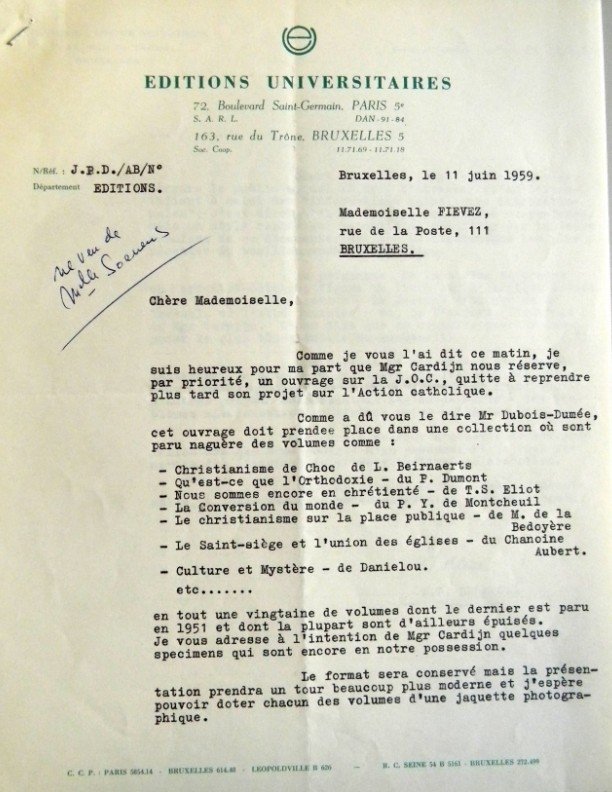
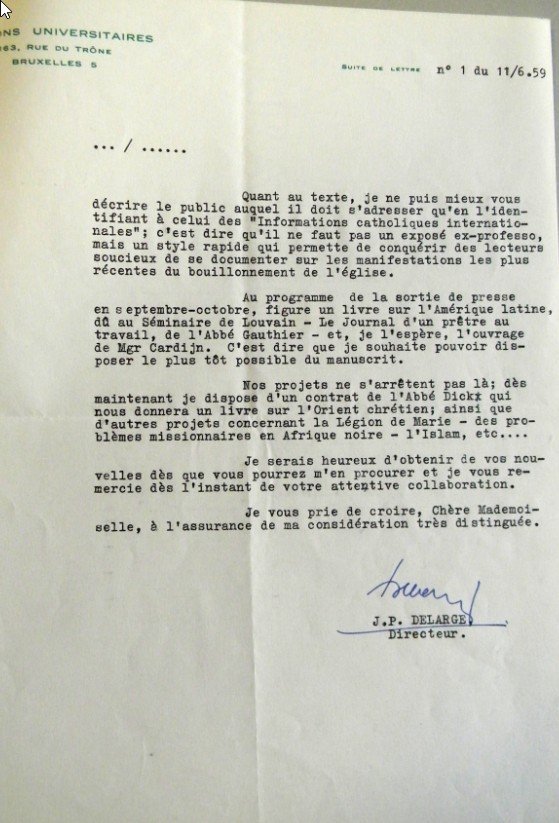
On 11 June 1959, Jean-Pierre Delarge writes to Marguerite Fiévez with details of a proposal for two books by Cardijn, one on the JOC, and one on Catholic Action.
SOURCE
Archives Cardijn 1778
On 9 June 1959, Cardijn wrote to Rosemary Goldie, an Australian who had studied theology in Paris who was now working at the COPECIAL secretariat in Rome, to thank and congratulate her on the publication of the three volume proceedings of the Second World Congress on Lay Apostolate in 1957.
But, as always, Cardijn also took the opportunity to raise other issues, particularly formation for the lay apostolate for both priests and lay people.
“The leaders of the Permanent Committee know how much I am concerned with the formation of lay people for the apostolate; essential formation
“As long as all clergy, like all laity, fail to be imbued with the need for this formation and do not seek to adapt it, especially to the life problems of young adults, I fear that an effective response will not be given. to the predominant needs of the modern world,” Cardijn wrote.
“I ardently hope that the Permanent Committee will continue and extend its research on the formation of an authentic Christian laity, to the dimension of this world which is expanding in all fields. With respect to this, would it not be the moment to do a special study on the apostolate of the laity and contact with non-Christians, the union of Churches, etc.?
“I believe that this is an important aspect of the ecumenism issue and for the preparation of the Council,” he concluded, showing that preparation for Vatican II was already becoming a key concern.
SOURCES
French original
Cardijn – Rosemary Goldie 1959 06 09 (Joseph Cardijn Digital Library)
English translation
Cardijn – Rosemary Goldie 1959 06 09 (Joseph Cardijn Digital Library)
Ruth Lee, Goldie, Rosemary (The Encyclopaedia of Women and Leadership in XXth century Australia)
On 17 May 1959, John formally appointed an Antepreparatory Commission to provide initial direction and begin the massive task of technical planning for the Council.
The Commission was charged with the following tasks:
(1) to contact the bishops of the world for their advice and suggestions,
(2) to gather proposals from the dicasteries of the Roman Curia,
(3) to learn the views of the theological and canonical faculties of Catholic universities,
(4) to sketch the general lines of the topics to be discussed at the Council, and
(5) to suggest various bodies (Commissions, Secretariats, etc.) to prepare the Council’s agenda.
The President of the Commission was Secretary of State Cardinal Domenico Tardini, while the Secretary was Msgr. (soon to be archbishop) Pericle Felici, an auditor in the Sacred Rota.
The other ten members who worked in the various Curial Congregations were:
Giuseppe Ferretto, Consistorial
Pietro Sigismondi, Propagation of the Faith
Antonio Samoré, Extraordinary Affairs
Acacio Coussa, Eastern Church
Cesare Zerba, Sacraments
Pietro Palazzini, Council
Arcadio Larraona, Religious
Dino Staffa, Seminaries and Universities
Enrico Dante, Rites
Paul Philippe, Holy Office.
Of these, Cardijn had already been in regular contact for several years with and received assistance from Archbishops Samoré and Pietro Sigismondi and he would soon get to know Cardinal Tardini too.
PHOTO
Cardinal Tardini with John XXIII (Holy Family of Nazareth Foundation)
On 25 March 1959, Cardijn wrote to Mgr Alberto Castelli, the vice-president of the Ecclesiastical Commission of the Permanent Committee for International Lay Apostolate Congresses (COPECIAL), to propose that the committee should look at expanding and upgrading its aims and resources at its forthcoming conference in Montallegro.
“Looking at the program, I regret that only relatively secondary problems, e.g. initiatives to be taken, etc., will be discussed at the planned meeting,” Cardijn wrote.
“Has not the time come to reflect together on the essential goals of the Permanent Committee, its ongoing role, and consequently to present to the Holy See, respectfully and in an attitude of very filial submission, suggestions regarding its structure and its activity. I know very well that this question was already briefly raised at a meeting by Miss Fiévez, but I personally wish to return to this question and emphasise its whole importance, because I believe that it is the key of the future of the Committee itself. I spoke to Mr Veronese about this several times and provided him with written notes on the subject.
“When we look the new structures of the world of today and tomorrow, the primordial importance of the formation of the laity in view of their irreplaceable apostolate in this new world, the need to form priests who are educators and animators lay apostles; the urgency of coordinating the apostolate of the laity and organising it in line with today’s world; the need for an insertion of this lay apostolate into the overall apostolate of the Church and its unbreakable link with the Hierarchy… when one penetrates the concrete and living content of these problems which require a positive and dynamic solution, one cannot avoid the conclusion that there is a need for a Church Institution – Dicastery, Commission, Congregation, whatever name is given to it – which can inform, inform, propose, suggest and study overall or partial solutions based on enquiries, studies and experiences that are properly evaluated and tested.
“And since all these problems are inseparable – problems of young people and adults; problems of formation, action and organisation; specialisation and coordination issues; problems of exchanges, achievements and representation; financial problems and management training problems – this Institution must have the resources to provide both documentation and expertise and above all, it needs to have sufficient authority, both in terms of the value and experience of its leaders as well as enjoying the confidence both of Hierarchical Authorities and lay organisations or institutions.
“When I think of the resources available certain world secular institutions, I can only regret the insufficiency and powerlessness of a Permanent Committee that needs to become the engine and the inspiration for so many people, acting individually or collectively, who have only one desire with respect to the problems in all continents and in every, namely to serve the Church and spread the Reign of Christ in a world that needs and aspires to it more than at any other time in history,” Cardijn concluded.
It was a theme that he would return to many times in the future.
SOURCE
Original French
Cardijn – Castelli 25 03 1959 (Joseph Cardijn Digital Library)
English translation
Cardijn – Castelli 25 03 1959 (Joseph Cardijn Digital Library)
Just two weeks after Cardijn and Romeo Maione’s audience with John XXIII, the new pope followed the example of his predecessors Pius XI and Pius XII by addressing an autograph letter to Cardijn dated 24 February 1959.
“To Our dear Son Joseph Cardijn, General Chaplain of the Young Christian Workers,” the letter read.
“Over the course of the already distant years since its foundation in Belgium, the Young Christian Workers movement has received the most explicit encouragements from Our venerated Predecessors Pius XI and Pius XII on numerous and solemn circumstances. With all our heart, We confirm these; and in our own turn We are pleased to offer you all Our paternal affection, to you who by your priestly zeal was the initiator of this vast Movement of Catholic Action, and, through you, to all the dear Jocists of the male and female branches that have now spread to every continent.
eWe well understand and value the apostolic work that they are achieving among young workers. They will take care to faithfully follow the precious directives received from the Holy See, particularly those that Pius XII of holy memory addressed to them during the great world assembly in 1957. Thus, they will remain apostles docile to the Hierarchy, well instructed in their faith and penetratedby Christian charity, and attentive to the living and working conditions of all their brothers in all locations, ardently in the service of God’s cause!
eWe pray to the Lord, through the intercession of the Immaculate Virgin, to make fruitful all these generous efforts and We willingly grant to you, to the presidents, leaders, chaplains and to all the Members of the Young Christian Workers Our most paternal Apostolic Blessing,” it concluded.
SOURCE
Jean XXIII, Lettre autographe (Joseph Cardijn Digital Library)
English translation
John XXIII, Autograph letter (Joseph Cardijn Digital Library)
Among the first to realise the Council’s potential was the theologian, Yves Congar, who had begun to work with Cardijn and the JOC during the early 1930s, giving retreats to JOC leaders at the Saulchoir, the Dominican convent then located at Kain, near Tournai in Belgium.
Subsequently, Congar continued to work closely with the JOC and other Specialised Catholic Action movements, culminating in his publication in 1953 of “Jalons pour une théologie du laïcat.” This was later translated into English as “Lay People in the Church.”
Nevertheless, his work had also attracted the attention of the Holy Office, the Vatican body responsible for doctrine. Along with several colleagues, he had been banned from teaching. As a result, he was transferred to Jerusalem at his own request and later sent to England and was eventually assigned to Strasbourg, where Archbishop Weber was more open to him.
Congar therefore took a keen interest in Pope John’s announcement of a Council. Within three weeks of its announcement, in mid-February 1959, he wrote suggesting five areas of work that thought the Council would do well to focus on (Giuseppe Alberigo, “The Announcement of the Council: From the Security of the Fortress to the Lure of the Quest,” in Alberigo-Komonchak, I, 35).
These included:


